Best Video Transcription APIs in 2026 (YouTube, TikTok, Instagram)
Video content is growing faster than most teams can keep up with. YouTube alone sees over 500 hours of video uploaded every minute, and that number does not account for the billions of short-form videos published on TikTok, Instagram Reels, and Facebook every day. For developers, researchers, and content teams trying to extract value from that content programmatically, transcription is often the first step.
A good video transcription API removes the manual work. Instead of watching videos, downloading files, or copy-pasting text, you send a URL and get back structured text. That text becomes the foundation for summaries, search indexes, sentiment analysis, training data, content repurposing, and more.
The challenge is that not every transcription API is built the same way. Some focus on YouTube only. Some require complex authentication flows. Others are general-purpose speech-to-text tools that require you to download the video first, then send an audio file. If your use case involves pulling transcripts from social media videos at scale, the differences between tools matter quite a bit.
This post covers the best video transcription APIs available in 2026, what makes each one worth considering, and which is the best fit depending on your situation.
What Makes a Great Video Transcription API?
Before getting into specific tools, it helps to define what separates a reliable transcription API from a frustrating one. These are the criteria used to evaluate each option below.
Platform coverage. Does the API support the platforms you actually use? A tool that only handles YouTube is a significant limitation if you also need TikTok transcripts or Instagram Reels captions.
No OAuth or authentication headaches. Many social media APIs require users to log in with their account, go through an OAuth flow, or connect a platform credential. For programmatic use cases, this creates friction and maintenance overhead. The best tools work without requiring your users to authenticate.
Output quality and structure. Raw transcripts are only useful if they are accurate and easy to work with. Timestamped segments, clean formatting, and support for different languages all matter.
Supplementary data. Transcripts are more powerful when they come alongside engagement metrics, video metadata, AI-generated summaries, and comments. Tools that bundle this data in a single response save you extra API calls.
Ease of integration. Developer-friendly documentation, predictable response formats, and support for no-code tools like Zapier, Make, and n8n all lower the barrier to getting started.
Pricing and scalability. Credit-based pricing with clear per-request costs is easier to reason about than seat-based or project-based models, especially for teams processing high volumes.
With those criteria in mind, here are the best video transcription APIs for 2026.
1. SocialKit
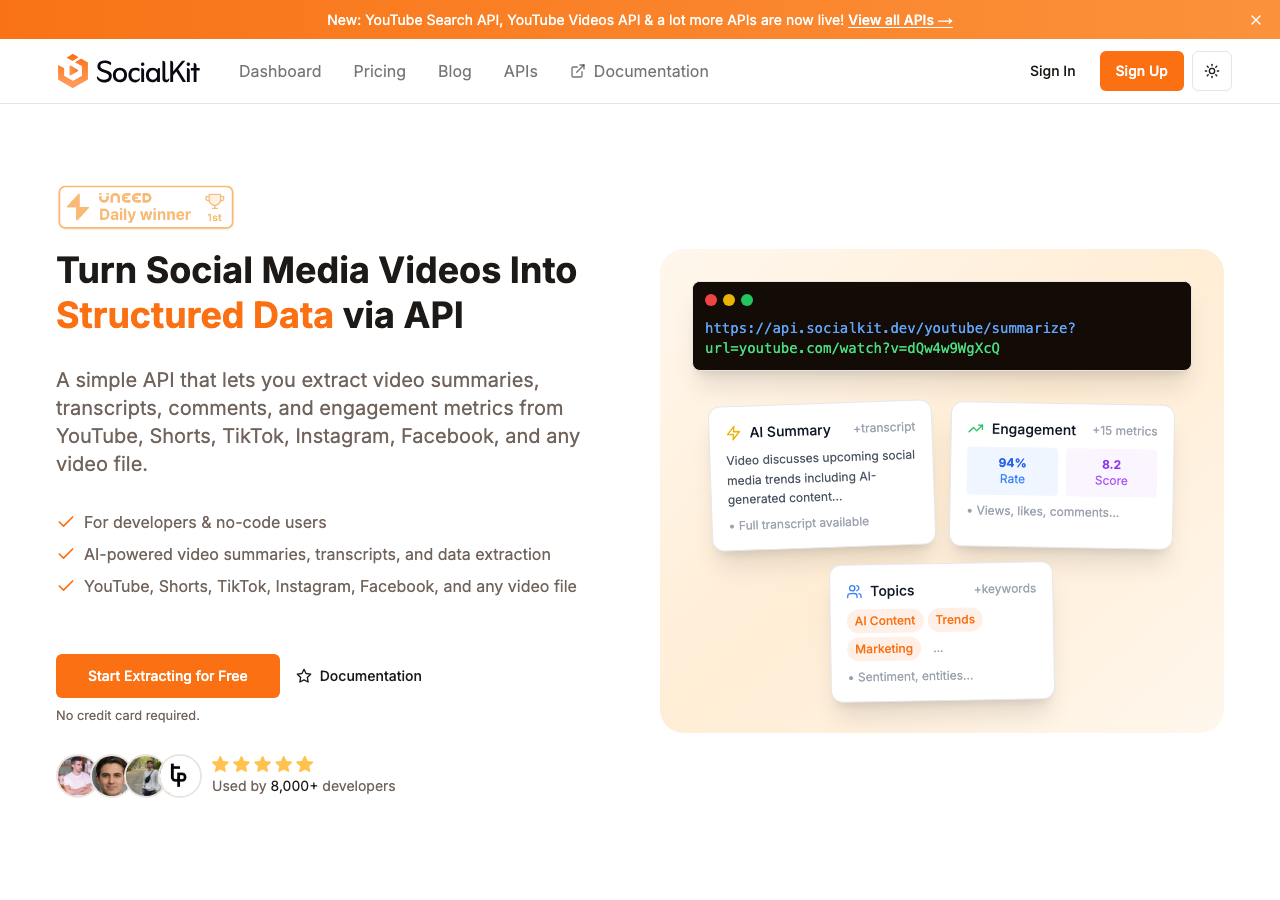
SocialKit is a social media video data API built specifically for extracting structured data from videos across YouTube, TikTok, Instagram, and Facebook. It is the most complete option on this list for teams that need transcripts alongside rich video context, all from a single API call.
The core idea behind SocialKit is that video transcription is rarely the end goal. Developers and content teams want to understand a video, not just read its words. SocialKit reflects that by returning transcripts, AI-powered summaries, engagement metrics, comments, and metadata in a single structured response. You send a video URL, and you get back everything you need to work with that content.
Key Features
SocialKit's video transcript API supports all four major social video platforms: YouTube, TikTok, Instagram, and Facebook. Whether you are pulling a YouTube transcript, an Instagram Reels transcript, a TikTok transcript, or a Facebook video transcript, the same API structure applies across all of them.
No OAuth is required. You do not need to connect a social media account or walk users through an authentication flow. SocialKit works with just a video URL and your API key, which makes it straightforward to integrate into automated pipelines.
In addition to transcripts, each API call can return an AI-powered summary of the video content. This is particularly useful for content teams using SocialKit for content repurposing or researchers running market research workflows. Rather than processing the raw transcript yourself, SocialKit delivers a ready-to-use summary in the same response.
For teams working with comments and engagement data, SocialKit also includes a YouTube comments API and a TikTok comments API, which opens up use cases like sentiment analysis and UGC analysis without needing a separate data provider.
No-code users are not left out. SocialKit integrates with Zapier, Make, and n8n, which means non-developers can build automated workflows that pull video transcripts into Google Sheets, Notion, Airtable, or any other tool their team uses.
There are also free tools available for users who want to explore the data before committing to a plan. The YouTube transcript extractor, TikTok transcript extractor, and Instagram transcript extractor let you test the output quality on real content.
Supported Use Cases
SocialKit is well-suited for a wide range of workflows. Developers building AI RAG applications can use video transcripts as document sources for retrieval-augmented generation pipelines. Content teams can use it for video script extraction, content ideation, and identifying viral clips. Agencies running influencer marketing campaigns can pull transcript and engagement data for creator research without manual effort.
Pricing
SocialKit offers tiered pricing based on credit volume, with plans available at socialkit.dev/pricing. Credits cover API calls across all supported platforms, and there is a free tier available to get started without a credit card.
Verdict
SocialKit is the best video transcription API for teams that need more than raw text. The combination of multi-platform support, no OAuth, AI summaries in the same response, and no-code integrations makes it the most practical choice for both developers and content teams in 2026. If you are building any kind of workflow that touches social media video content, SocialKit is the right place to start.
2. ScrapeCreators
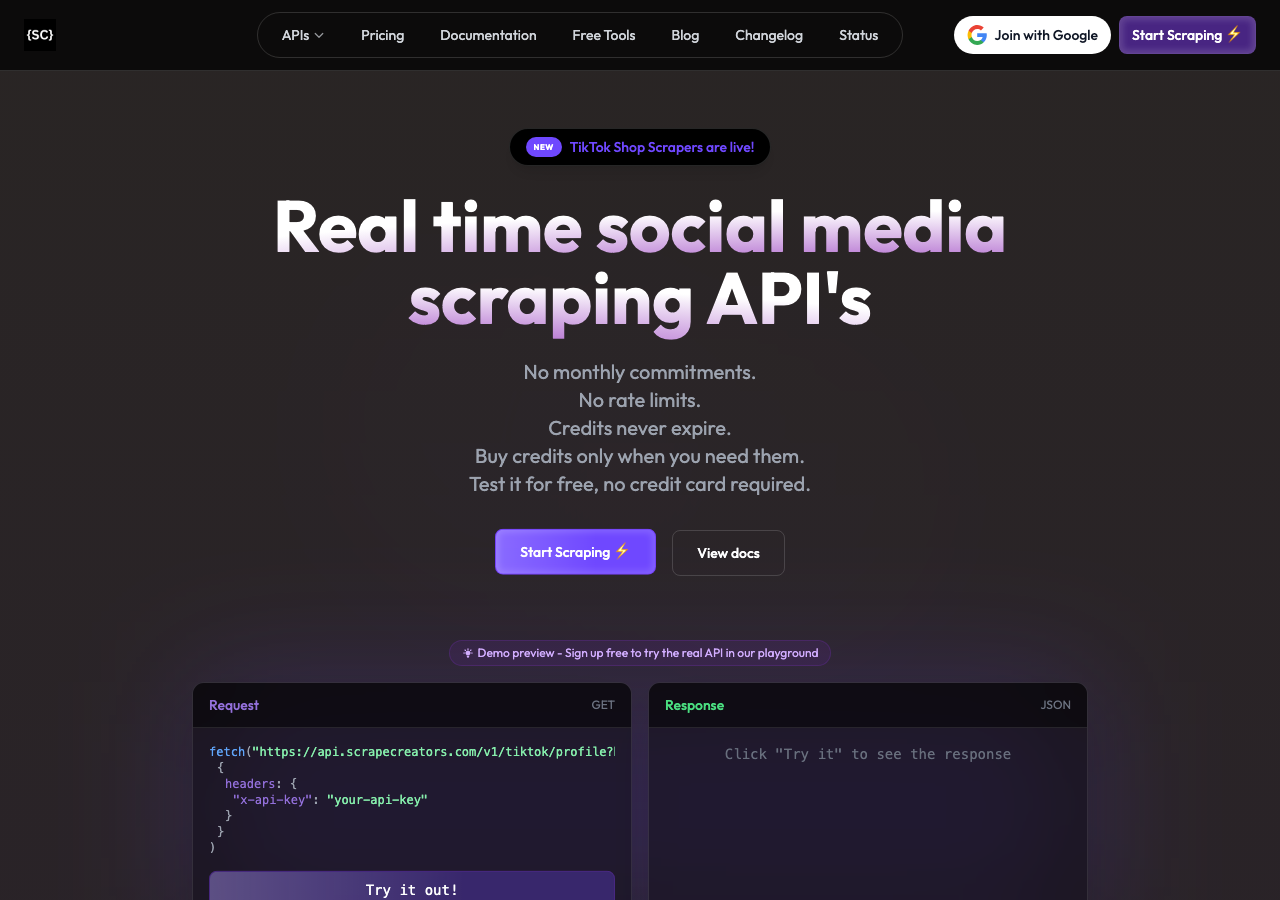
ScrapeCreators is a social media data API that covers transcript extraction across multiple platforms including YouTube and TikTok. It is positioned as a general-purpose social media scraping tool with transcript support as one of its core features.
Key Features
ScrapeCreators offers transcript and metadata extraction for video URLs. It supports several platforms and has a developer-first design. The API documentation is reasonably clear, and the response structure includes video metadata alongside transcript data.
One consideration with ScrapeCreators is that its feature set is more focused on raw data extraction. It does not include AI-generated summaries natively, so teams that want summarized output alongside transcripts will need to add a separate processing step. For workflows where you are already processing text with your own models, this may not be a limitation.
Pricing
ScrapeCreators pricing information is available on their website. Plans vary by volume and feature access. A full comparison of capabilities is available on the SocialKit vs ScrapeCreators page.
Verdict
ScrapeCreators is a reasonable option for developers building custom pipelines who want raw transcript and social data without needing bundled AI summaries. SocialKit offers a more complete response per API call, which reduces the total number of integrations needed for most use cases.
3. Supadata
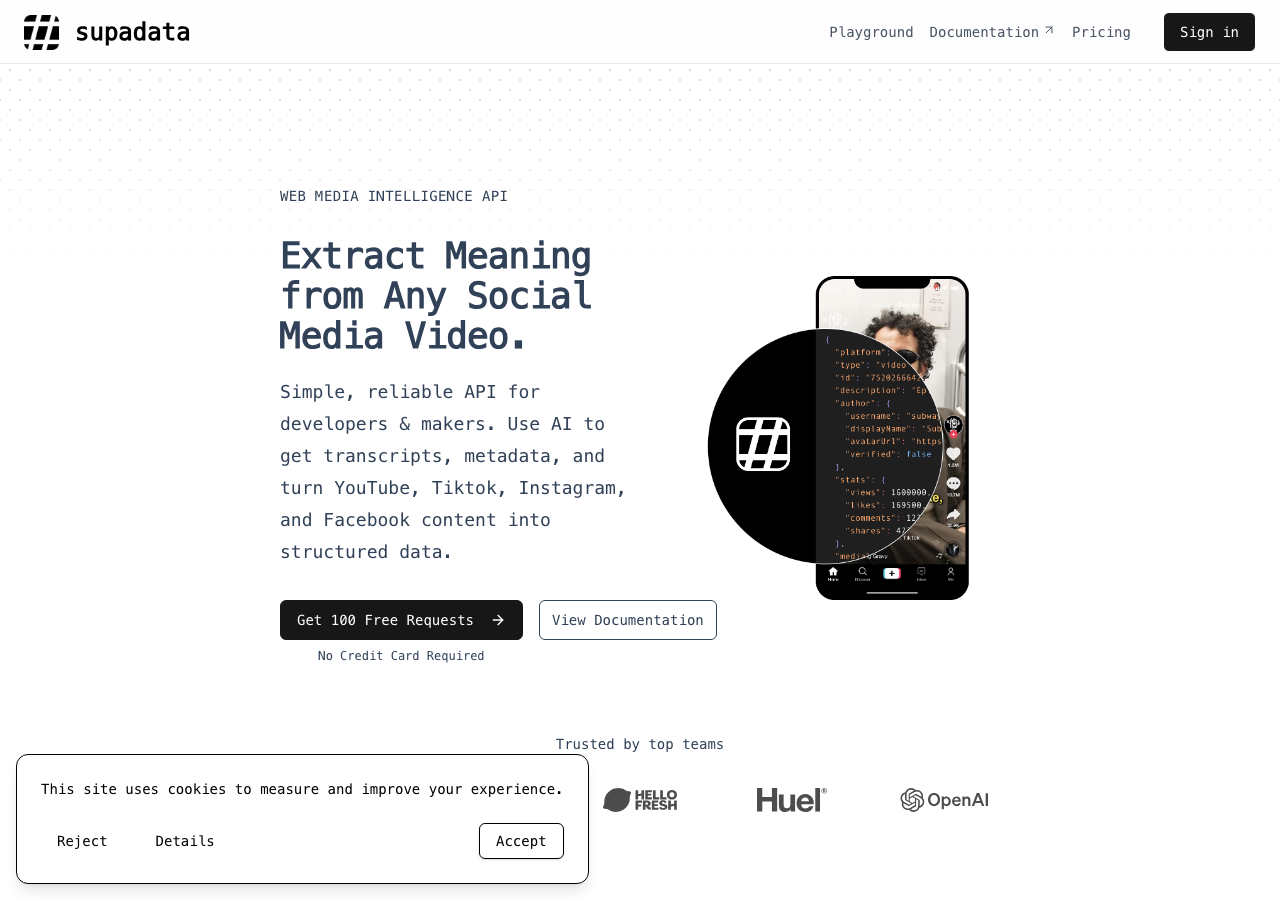
Supadata is a data API that includes transcript extraction for YouTube and a handful of other platforms. It is a developer-focused tool with clean documentation and a straightforward credit-based pricing model.
Key Features
Supadata offers YouTube transcript extraction along with some channel and video metadata. Its API is designed to be simple to use, with clear response formats and reasonable rate limits depending on the plan tier. The service is built for developers who want programmatic access to video transcript data without a lot of setup.
Platform coverage is more limited than SocialKit. Supadata is primarily centered on YouTube, which is fine for teams whose use cases only involve that platform, but it becomes a constraint if you also need TikTok, Instagram, or Facebook support.
Pricing
Supadata uses a credit-based model. The Basic plan starts at $5 per month for 300 credits, the Pro plan is $17 per month for 3,000 credits, the Mega plan is $47 per month for 30,000 credits, the Giga plan is $297 per month for 300,000 credits, and the Supa plan is $897 per month for 1,000,000 credits. Auto-recharge is available on the Pro tier and above.
Verdict
Supadata is a solid choice for YouTube-focused transcript extraction with predictable pricing. If your workflow is entirely YouTube-based and you do not need AI summaries or comments in the same response, it is worth evaluating. For broader platform coverage, SocialKit is the stronger option. You can also read a detailed comparison on the SocialKit vs Supadata alternatives page.
4. DumplingAI
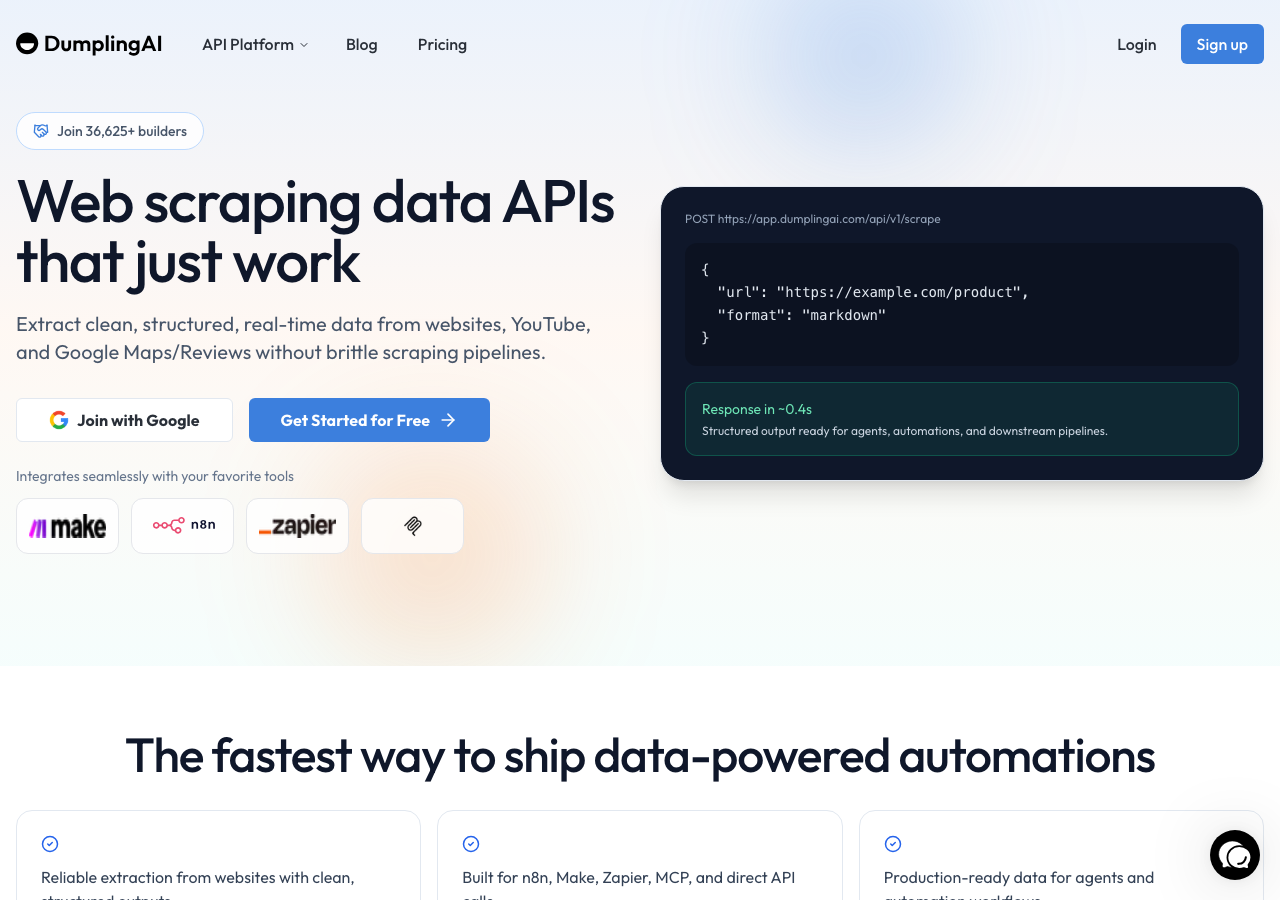
DumplingAI is an AI-focused data API that includes YouTube transcript extraction as part of a broader suite of tools. It is designed with AI application developers in mind and offers features that go beyond basic transcription.
Key Features
DumplingAI includes YouTube transcript extraction, web scraping, and several AI-oriented data endpoints. For developers building AI applications who need video transcript data alongside other content types, the unified API can reduce the number of separate services they need to manage.
The platform does include some AI processing features, which is useful for teams building retrieval or summarization pipelines. However, its social media video coverage is narrower compared to SocialKit, and the pricing structure is higher for teams primarily focused on transcription use cases.
Pricing
DumplingAI offers plans at $10 per month, $49 per month, $149 per month, and $299 per month. Pricing scales with usage volume and access to advanced features.
Verdict
DumplingAI is a reasonable option for developers who need a broader set of AI data tools in one place and whose transcript needs are mostly YouTube-focused. For teams that need multi-platform transcript extraction with lower cost per request, SocialKit provides more value. See the full comparison on the SocialKit vs DumplingAI page.
5. Reduct
Reduct is a video transcription and editing platform aimed at teams that work heavily with recorded video content such as interviews, research sessions, and legal proceedings. It is not primarily an API product, but it is worth including for teams that need a workflow-oriented transcription tool rather than a programmatic integration.
Key Features
Reduct offers fast and accurate transcripts, a text-based video editor, translation capabilities, and organizational tools for managing large libraries of video content. Its standout feature is the ability to search across video content using text, essentially treating transcripts as a searchable index of your video library.
The platform is designed for teams dealing with qualitative research, user interviews, journalism, legal workflows, and similar use cases where reviewing large amounts of recorded content is part of the day-to-day work. It supports features like clip extraction, highlighting, and collaborative review.
Reduct is not built for automated social media data extraction. It does not offer a URL-based API for pulling transcripts from YouTube or TikTok at scale. If your use case is processing hundreds or thousands of social videos programmatically, it is not the right fit.
Pricing
Reduct offers seat-based plans starting at $75 per editor per month, as well as project-based and utilization-based models. A free trial is available.
Verdict
Reduct is a good fit for teams that need a collaborative, text-based interface for working with video content, particularly in research, legal, or editorial contexts. For developers building automated pipelines or needing social media video transcripts at scale, SocialKit is the more appropriate tool.
Quick Comparison Table
| Tool | Platform Coverage | Transcript API | AI Summaries | No OAuth | No-Code Integrations | Pricing Starting At |
|---|---|---|---|---|---|---|
| SocialKit | YouTube, TikTok, Instagram, Facebook | Yes | Yes | Yes | Zapier, Make, n8n | Free tier available |
| ScrapeCreators | YouTube, TikTok | Yes | No | Yes | Limited | Free tier available |
| Supadata | YouTube (primary) | Yes | No | Yes | Limited | Free tier available |
| DumplingAI | YouTube (primary) | Yes | Partial | Yes | Limited | $10/month |
| Reduct | Uploaded video files | Yes | No | N/A | No | $75/editor/month |
Which Should You Choose?
The right tool depends on what you are building and which platforms matter to your workflow.
If you need multi-platform social media video transcripts at scale, SocialKit is the clearest choice. It covers YouTube, TikTok, Instagram, and Facebook, requires no OAuth, returns AI summaries alongside transcripts, and supports no-code automation tools. Whether you are building a content repurposing pipeline, an AI knowledge base, or a social media monitoring tool, SocialKit handles the data extraction layer so you can focus on the application.
If your use case is purely YouTube and you want simple, low-cost transcripts, Supadata is a solid option with transparent pricing and a clean API. The tradeoff is that you will need additional tools if your needs expand beyond YouTube or if you want summaries and engagement data in the same response.
If you are building a broader AI application that needs more than just video transcripts, DumplingAI offers a suite of AI-oriented data tools in one place, though the pricing is higher and platform coverage is more limited.
If your team works primarily with recorded interviews, research sessions, or meeting recordings rather than social media video, Reduct is worth evaluating. Its collaborative editing and search features are genuinely useful for qualitative research workflows.
For most developers and content teams reading this post, the decision comes down to SocialKit versus one of the narrower options. The key question is whether you need cross-platform coverage and bundled metadata in a single API call, or whether a single-platform transcript tool is sufficient. If your requirements might expand in the future, starting with the more complete solution avoids having to migrate later.
Conclusion
Video transcription APIs have become a core piece of infrastructure for teams working with social media content. Whether you are building an AI application, a content operations workflow, a research tool, or a social media analytics platform, the ability to extract clean, structured transcript data from video URLs programmatically changes what is possible.
SocialKit stands out in 2026 because it treats transcription as one piece of a larger data extraction problem. Multi-platform support across YouTube, TikTok, Instagram, and Facebook, combined with AI summaries, engagement metrics, comments, and no-code integrations, makes it the most practical starting point for developers and content teams alike.
If you want to see what the API returns on a real video, try one of SocialKit's free tools: the YouTube transcript extractor, TikTok transcript extractor, or Instagram transcript extractor. You can also explore the full set of available APIs or review the use cases to find the workflow that matches what you are building.